Author: raisedtoknowgod

  • “Ruth: Teaching Your Child What Loyalty Really Means”

    Your child probably knows the story. A widow. A field. A man who treats her kindly. They get married. The end.

    But Ruth’s story isn’t really about romance. It’s about something kids actually need to understand: loyalty. Keeping your word when it’s hard. Staying faithful even when life breaks you.

    And it’s a story parents often skip—not because it’s bad, but because we’re not sure what to do with it. How do you explain it to a kid without it feeling like an old, dusty history lesson?

    Here’s the thing: Ruth’s story is about showing up. It’s about choice. And your kids need that.

    Ruth was a Moabite woman—which means she wasn’t Jewish. She married an Israelite man and had a life. Then her husband died. Her father-in-law died too. Suddenly she was a foreigner, poor, and alone.

    In that culture, that was the end of your story. No husband, no father, no protection. She could have left her mother-in-law Naomi, gone back to her own people, and tried to start over.

    But she didn’t.

    Instead, Ruth said to Naomi: “Where you go, I will go. Where you live, I will live. Your people will be my people. Your God will be my God” (Ruth 1:16).

    That’s loyalty. That’s the whole story right there.

    Why This Matters

    Kids today live in a culture of convenience. Don’t like your friend? Get a new one. Relationship gets hard? Leave. Commitment feels tough? Opt out.

    Ruth shows something radically different: loyalty when it costs you. Faithfulness when nobody’s watching. Staying committed to someone even when you have nothing to gain.

    And here’s the kicker—Ruth didn’t stay because it was easy or because she expected a reward. She stayed because it was right. Because she had made a choice, and she kept it.

    That’s what your child needs to learn. Not “be loyal because you’ll get something out of it,” but “be loyal because it’s who you are.”

    Start here: “Do you know what loyalty means?”

    Let them answer. They’ll probably say something like “sticking with your friends” or “not leaving someone.” Good. They’ve got the basics.

    Then tell the story simply:

    “Ruth’s husband died. Her father-in-law died. She had nothing. Her mother-in-law Naomi said, ‘You should go. You’re young. You can find a new life.’ But Ruth said, ‘No. I’m staying with you. You’re my family.’ Even though it was hard. Even though she had nothing. She stayed.”

    Ask them: “Why do you think Ruth stayed? What does that tell us about who she was?”

    Listen to their answers. Kids often get this instinctively. They understand loyalty even when we don’t explain it perfectly.

    Connect it to their life: “Have you ever stuck with someone even when it was hard? What made you stay?”

    Maybe it’s a friendship. Maybe it’s their sibling (even when they’re annoying). Maybe it’s you—staying with them even when parenting is hard. Let them see loyalty in action.

    The Part Parents Miss

    Here’s what most people skip: Ruth worked. She went to the fields and picked grain. She did hard, humble work to survive and to help Naomi. She didn’t complain. She didn’t ask for special treatment. She just showed up and did what needed to be done.

    That’s part of loyalty too. It’s not just feeling faithful. It’s acting faithful. It’s showing up and doing the work.

    You can talk to your child about this: “Ruth didn’t just say she was loyal. She showed it by working hard and taking care of Naomi.”

    Try This Activity Together

    Draw a “loyalty map”:

    • In the middle, write “Ruth”
    • Around her, write the people she was loyal to (Naomi, her community, her God)
    • For each one, write what she did to show that loyalty
    • Then do one for your child: Who are you loyal to? What do you do to show it?

    Or ask this question: “If loyalty was a superpower, what would it look like? How would Ruth use it?”

    Let them draw, write, or just talk about it. The point isn’t a perfect answer—it’s helping them see loyalty as something active, something they actually do.

    Ruth marries Boaz. She has a son. That son becomes the grandfather of King David. She goes from being a foreigner with nothing to being part of Jesus’s family line.

    Not because she earned it. Not because she was trying to get somewhere.

    But because she was faithful. Because she kept her word. Because she showed up.

    That’s the promise at the heart of her story: Loyalty matters. Your faithfulness doesn’t go unnoticed. And sometimes the hardest choice—choosing to stay, choosing to commit, choosing to show up—is exactly what changes everything.

    Your child doesn’t need to understand all of that yet. But they need to know: loyalty is a choice, and it matters.

    One More Thing

    When you teach this story, don’t just make it about Ruth. Make it personal. Talk about loyalty you’ve seen in your own life. Maybe it’s a friend who stuck with you. Maybe it’s a parent who showed up for you. Maybe it’s you, staying committed to your child even on the hard days.

    Kids learn what loyalty is by watching it. By seeing it. By experiencing it from the people who love them.

    Ruth’s story teaches that lesson. And so does yours.


  • “Why Can’t I See God? (And Why That Doesn’t Matter)”

    Your child asks it. You’ve probably asked it too.

    If God is real, why can’t I see Him?

    It’s one of those questions that sounds simple on the surface but matters deeply. And the honest answer? The Bible teaches that God is spirit, which means our physical eyes literally cannot see Him. But here’s what changes everything: you can’t see a lot of things that are real and true, and yet you believe in them anyway.

    What the Bible Teaches

    God is spirit. That means He’s not confined to physical form or a location. We don’t meet God the way we meet a friend—by seeing their body and hearing their voice with our ears. Instead, we know Him through what He’s revealed to us: through His Word in Scripture, through creation, and through His work in our lives and the world.

    The Bible puts it plainly: “God is a Spirit” (John 4:24)

    So What Does This Mean For Your Family?

    Here’s the thing: your child lives in a world obsessed with proof. Show me. Let me see it. Make it real. And then we’ll believe.

    But faith doesn’t work that way. Faith is the substance of things hoped for, the evidence of things not seen. Your kid needs to understand that not being able to see something doesn’t make it less real—it actually requires a different kind of knowing.

    How to Talk About It With Your Kids

    Ask them: “What’s something you can’t see but know is real? Wind? Gravity? Love?”

    Most kids will get it. A 7-year-old can understand that the wind moves the trees even though she can’t see the wind itself. She can feel it. She can see what it does. She can experience it, even though she can’t see it with her eyes.

    Then connect it: “God is like that. We can’t see Him with our eyes, but we can know Him, experience Him, and see what He does in the world and in our hearts.”

    Try This Activity Together

    Draw something you can’t see but know is real. It might be wind, gravity, radio waves, thoughts, or love. Write down how you know it’s real, even though you can’t see it. Then talk about how that’s a little bit like knowing God—we know He’s real through His effects and His revelation, not through our eyes.

    Growing in Faith

    You don’t need to see something to believe in it or to love it. Your child’s faith doesn’t depend on a dramatic vision or physical proof. It depends on knowing God’s Word, experiencing His presence in prayer and community, and watching how He moves in the lives of those around them.

    This is actually good news. It means God is accessible to everyone—not just to people who’ve had some special experience or vision. Faith is built through relationship and revelation, and that’s available to all of us.


    “How to Have Faith Conversations That Actually Stick (It’s Simpler Than You Think)”

    You want your kids to have real faith. Not just Sunday faith. Not just the faith they repeat back to you because they know it’s what you want to hear. But actual, lived-out, walking-with-God faith.

    So you try to have faith conversations.

    Sometimes they listen. Sometimes your 8-year-old stares at you like you’re speaking another language. Sometimes your teenager pulls out their phone mid-sentence. And sometimes you realize you don’t actually know what you’re trying to say.

    If this sounds familiar, you’re not alone. Most parents struggle with this not because they don’t care, but because nobody ever taught them how.

    Here’s the good news: it doesn’t have to be complicated.

    The Problem With Most Family Faith Talks

    We often make faith conversations too formal. We wait for the right moment—the car ride home, a Sunday morning, a family dinner—and then we launch into something that feels rehearsed or heavy. Our kids sense the shift. They know something’s different. And sometimes they check out before we even start.

    Or we do the opposite. We try to be so casual and natural that the conversation never actually happens. We think, I’ll just model faith and they’ll catch it, which works to a point. But kids need explicit conversations too.

    The middle ground? A simple framework that works in real moments, not just planned ones.

    The Framework: READ • TALK • LEARN • PRAY • LIVE IT OUT

    This isn’t rocket science, but it works because it’s simple enough that you can actually use it.

    READ — Start with Scripture. This could be:

    • A passage you read together at breakfast
    • Something one of your kids brings up from church
    • A verse that relates to something happening in your family right now
    • Even a Bible story you tell from memory

    You’re not aiming for perfection here. You just need one small piece of Scripture to start.

    TALK — Ask questions about it. Not “Do you understand?” (Too broad. Too easy to fake a yes.) But real questions:

    • “What do you think this means?”
    • “When have you seen this happen in real life?”
    • “What’s confusing about it?”
    • “How does this change what you thought about God?”

    Your job is to listen more than you talk. Your kids’ questions matter more than your answers.

    LEARN — This is where you dig a little deeper. Not a sermon. Just genuine learning together:

    • What does God’s Word actually teach here?
    • What have trusted teachers or mentors said about this?
    • How have you seen this work out in your own life?

    Keep it accessible. You don’t need seminary training for this part.

    PRAY — Turn it into conversation with God. This could be:

    • A simple prayer out loud: “God, we’re confused about this. Help us understand.”
    • Silent prayer where everyone prays about what was discussed
    • Writing down what you want to ask God about
    • Just sitting quietly and listening

    Prayer isn’t about perfect words. It’s about bringing what you just learned into relationship with God.

    LIVE IT OUT — Plan one small way this changes how you live this week:

    • “We’re going to try trusting God in this one situation and notice what happens”
    • “This week when I’m tempted to [X], I’m going to remember what God’s Word says about [Y]”
    • “Let’s watch for examples of this in the world around us and come back next week with what we noticed”

    This is where faith moves from head knowledge to lived experience.

    Real Example: You See Your Child Being Left Out

    Scenario: Your child comes home upset because they weren’t included in something at school. This is a teaching moment.

    READ: “The Bible talks about how Jesus was rejected too, and how He knows what it feels like to be left out.”

    TALK: “Has that ever happened to you? How does it feel knowing Jesus experienced that?”

    LEARN: “Jesus didn’t respond by trying to get revenge or by stopping to care what people thought. He kept loving and kept moving forward. We can do the same.”

    PRAY: “God, it hurts when we’re left out. Help us respond like Jesus would.”

    LIVE IT OUT: “This week, let’s notice: when you feel left out or lonely, what helps you remember that Jesus is with you? Is it praying? Talking to someone? Reading Scripture?”

    That’s it. That’s a real faith conversation. No performance. No fake piety. Just connecting what they’re experiencing to what God’s Word teaches.

    Why This Framework Actually Works

    It works because:

    • It’s realistic. You can do this in 5 minutes or 30. At the dinner table or in the car.
    • It’s flexible. Use it with one question or all five. Adapt it to your family.
    • It’s connective. You’re not talking AT your kids; you’re talking WITH them and WITH God.
    • It’s repeatable. Once you do it a few times, it becomes natural.

    One More Thing

    You don’t have to have all the answers. In fact, sometimes the best faith conversations happen when you don’t. When you say, “I’m not sure, but here’s what I believe…” or “That’s a great question; let’s find out together.”

    Your kids don’t need you to be perfect. They need you to be real—walking with God, wrestling with faith, and taking their questions seriously.

    That’s discipleship. That’s raising kids who know God.


    “Your Child’s Friends Are Discipling Them (Whether You Like It or Not)”

    One of the most disorienting moments of parenting is realizing your child has become someone you don’t fully recognize, in ways you didn’t expect, on a timeline you weren’t prepared for.

    Sometimes it’s small. A phrase they picked up. A new interest. A different way of thinking about something. Sometimes it’s bigger—a shift in values, a change in what they care about, a departure from what you thought they believed.

    Often, we blame the internet. TikTok. Instagram. School. But there’s something we miss: your child’s friends are discipling them, and you’re not always in the room when it happens.

    This isn’t a condemnation. It’s just reality.

    What Does “Discipling” Even Mean?

    To disciple someone means to shape their thinking, values, beliefs, and behaviors—usually over time, usually through relationship.

    Parents often think of discipleship as a spiritual activity that happens during intentional teaching moments. Bible study at breakfast. A bedtime prayer. A conversation about faith.

    But discipleship is actually bigger than that. It’s what happens when someone spends time around another person and gradually becomes more like them. It’s the small moments more than the big ones. It’s proximity over perfection.

    And your child’s friends have a lot of proximity.

    How Friends Disciple Your Child (And You Might Not Notice)

    What’s cool/acceptable/normal
    A friend’s casual attitude toward honesty becomes your child’s casual attitude. A friend’s obsession with comparison and status becomes your child’s lens for evaluating themselves. A friend’s sense of humor—including what’s funny and what goes too far—becomes your child’s sense of humor.

    What matters/what’s worth caring about
    Does your child’s friend group care about kindness? Achievement? Looking good? Loyalty? Rebellion? Whatever the group prioritizes, your child learns to prioritize too. Often without anyone explicitly teaching it.

    What’s shameful/what’s normal to talk about
    A friend group determines what you can openly discuss and what must stay hidden. What’s embarrassing. What’s NBD. Your child learns which parts of themselves are acceptable to show and which must be hidden.

    What’s possible/what’s off-limits
    Friends expand or restrict your child’s sense of what’s actually possible. “Nobody I know is religious.” “Everyone vapes.” “Of course you have to get on TikTok.” “Good people in our grade don’t do that.” These become your child’s working assumptions about reality.

    Values that become non-negotiable
    Slowly, subtly, your child adopts their friends’ values as their own. Loyalty to the group. Loyalty to a cause. Authenticity (which sometimes means rebellion against authority). Fitting in. Standing out. By the time you realize it’s happened, it’s integrated.

    Here’s Why This Matters For Your Family’s Faith

    If you’re trying to raise a child who knows God—who actually believes it, who lets it shape their choices—you need to understand that you’re not the only voice discipling your child.

    This isn’t a problem if your child is in community with people who share your faith values. But if they’re not—if their friend group is largely secular or hostile to faith—then their friends are quietly, persistently discipling them away from what you’re trying to teach them.

    A child can have a faith-centered home and a friend group that doesn’t value faith. They’ll feel the tension. And most children, especially teens, will choose the belonging of their peer group over the teaching of their parents.

    It’s not because you’ve failed. It’s because you’re fighting biology. Humans are wired for belonging. During adolescence, belonging to peers becomes more important than pleasing parents. This is normal and healthy development.

    But it’s also a reality you can’t ignore if you want to raise kids who know God.

    What You Actually Do About This

    This isn’t a call to isolate your child or to control their friendships. That backfires. But it is a call to be intentional.

    Know your child’s friends and their families.
    Spend time around them. Not in a creepy, surveillance way. Just… know them. Know their values. Understand what they care about. If your child’s best friend comes from a secular background, that friendship isn’t bad—but you need to know it’s shaping your child’s worldview.

    Make your home a place where their friends want to be.
    This is huge. If your child’s friends feel welcome in your home, you get glimpses into their world. You become a quiet influence. You model faith, generosity, humor, and respect in real time. They see what a faith-centered life actually looks like, not in a preachy way, but in how you live.

    Have explicit conversations about peer influence.
    Don’t assume your child understands that their friends are shaping them. Talk about it openly: “I’ve noticed you’re really close with [friend]. I like them. I also want to make sure you know that the people we spend time with influence us—they shape what we think is cool, what we care about, what we believe. That’s not bad, it’s just real. So let’s keep talking about it.”

    Build community with kids who share your values.
    Youth group. Faith-based camps. Mentoring relationships. Sports teams with good kids. Find spaces where your child can have friendships with people who also care about faith. It won’t erase the influence of other friends, but it creates a counterbalance.

    Address the tension directly.
    If your child is caught between a friend group that doesn’t share their faith and a family that does, that’s hard. Don’t pretend it’s not. Say things like: “I know your friends don’t talk much about faith, and you care what they think. That’s normal. But I also want to help you stay connected to what you believe. Let’s figure this out together.”

    The Deeper Truth

    You cannot control who disciples your child. But you can be aware of it. You can create other spaces of influence. You can stay in relationship and keep conversations open. And you can trust that the faith you’re working to build in your home won’t be erased by a friend group with different values—but it will be tested.

    The kids who keep their faith as teenagers aren’t usually the ones who were sheltered from different perspectives. They’re the ones who:

    • Understood why their faith mattered to them (not just what to believe)
    • Had adults who took their questions seriously
    • Felt accepted at home even when they struggled or questioned
    • Had peer community that also valued faith
    • Saw faith lived out authentically, not just talked about

    Your friends are discipling your child. Use that as motivation to stay close, stay present, and stay in conversation about what they’re becoming.
  • How to Teach Your Child to Pray: A simple Guide for Christian Parents

    Prayer is one of the greatest gifts we can teach our children. It is more than teaching a child to say words before bedtime. It is helping them understand that they can talk to God, trust Him, thank Him, ask Him for help, and grow in their relationship with Him.

    Why Should We Teach Children to Pray?

    Prayer teaches children that God is not distant. They can speak to Him, bring their worries to Him, thank Him, ask Him for help, and learn to trust Him.

    We do not want prayer to become something children only do when they need something. We want them to understand that prayer is part of having a relationship with God.

    Jesus taught His disciples to pray, and as parents, we have the beautiful responsibility of helping our children develop that same habit.

    Start Simple

    A child does not need complicated words to pray.

    Teach your child that they can talk to God in simple, honest words.

    They can say:

    “Jesus, thank You for today.”

    “Lord, please help me at school.”

    “God, thank You for my family.”

    “Jesus, please help me when I am afraid.”

    The goal is not perfect words. The goal is helping your child understand that God hears them.

    Create a Daily Prayer Routine

    Choose simple moments during the day when prayer can become part of your child’s routine.

    You could pray:

    In the morning before school

    Before meals

    At bedtime

    Before a difficult situation

    After something good happens

    When someone needs prayer

    These small moments can help children see prayer as a natural part of everyday life.

    Let Your Child Hear You Pray

    Children learn by watching us.

    Let your child hear you praying about your own life, your family, their school, your decisions, and the things you are trusting God with.

    When children see their parents turning to God, they begin to understand that prayer is not just a religious activity. It is a way of depending on Him.

    Teach Them to Pray With Scripture

    The Bible gives children words they can use when they do not know what to say.

    You can take a simple Bible verse and turn it into a prayer.

    For example:

    “Lord, Your Word says that You are with me. Help me remember that You are with me wherever I go.”

    This helps children connect God’s Word with their prayer life.

    Make Prayer Personal

    Ask your child questions such as:

    “What would you like us to pray about today?”

    “Is there anyone you would like us to pray for?”

    “Is there anything you are worried about?”

    “What are you thankful to God for?”

    These questions help children understand that they can bring every part of their lives to God.

    Most Importantly, Point Them to Jesus

    Our goal is not simply to raise children who know how to say prayers.

    Our goal is to raise children who know God, trust Him, love His Word, and understand that they can come to Him through Jesus Christ.

    Prayer is not about saying the perfect words.

    It is about relationship.

    It is about teaching our children to turn their hearts toward God.

    A Simple Prayer You Can Pray With Your Child

    “Dear Jesus, thank You for loving me and caring for me. Help me to know You, love Your Word, and trust You every day. Help me when I am afraid, guide me when I do not know what to do, and teach me to always remember that I can come to You in prayer. Amen.”

    Start small. Pray often. Let your child see you seek God.

    Because sometimes, one of the greatest gifts we can give our children is teaching them that they can always talk to God.

    j

  • Bible Stories Under the Tree: Helping Children Know God

    Bible Stories Under the Tree: Helping Children Know God

    Bible stories have a beautiful way of helping children discover who God is.

    At Raised to Know God, we believe children can begin learning about God through simple stories, meaningful conversations, play and everyday moments.

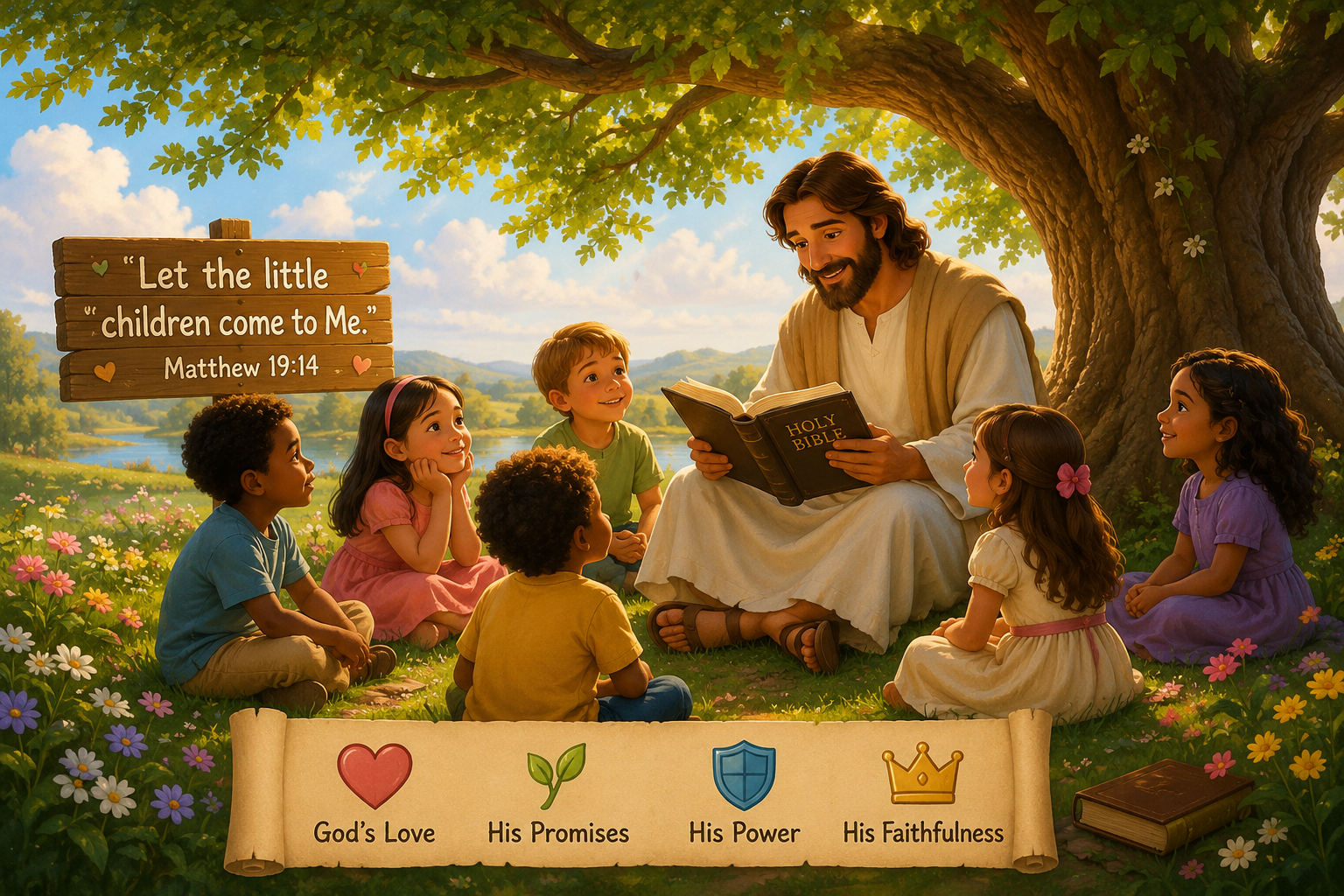
    From Noah and the ark to David and Goliath, the bible is filled with stories that teach children about God’s love, His faithfulness, His power, and His promises.

    Our goal is simple: to help children know God, love His word, and grow in faith.

    Bible Stories That Help Children Know God

    The Bible is full of stories that help children discover who God is and what He is like.

    Here are some Bible stories you can share with your child and the simple truths they can learn from each one.

    Noah and the Ark

    Noah trusted God even when he could not see what was coming. God gave Noah instructions to build and ark, and Noah obeyed.

    What children can learn:

    God is faithful. We can trust and obey Him, even when we do not understand everything.

    Bible verse:

    “By faith Noah….. built an ark to save his family.”

    Hebrews 11:7

    David and Goliath

    David was young and looked small compared with Goliath, but David trusted God. He knew that God was bigger than the giant standing in front of him.

    What children can learn

    We don’t have to be afraid when we trust God. God gives us courage to face things that seem bigger than us.

    Bible verse

    “The battle is the Lord’s.”
    1 Samuel 17:47

    Daniel in the Lions’ Den

    Daniel loved God and continued to pray to Him, even when he was told not to. Because Daniel trusted God, he was not alone when he was thrown into the lions’ den. God was with him and protected him.

    What children can learn

    God is always with us. We can pray to Him and trust Him, even when we are afraid.

    Bible verse

    “My God sent his angel, and he shut the mouths of the lions.”
    Daniel 6:22

    Jesus Welcomes the Children

    Jesus showed how much He loves children. When people tried to keep the children away, Jesus welcomed them and reminded everyone that children are important to God.

    What children can learn

    Jesus loves children. They can come to Him, talk to Him, pray to Him, and learn His Word.

    Bible verse

    “Let the little children come to Me.”
    Matthew 19:14

    Making Bible Stories Part of Everyday Life

    You don’t need a complicated Bible lesson to help your child know God. Small, consistent moments can make a lasting difference.

    Read a Bible story together. Ask your child what they noticed. Talk about what the story teaches us about God. Then connect it to something they experience in everyday life.

    You could ask:

    “What do you think this story teaches us about God?”

    “What would you do if you were in this story?”

    “How can we trust God today?”

    “What can we pray about together?”

    The goal isn’t simply for children to remember Bible stories. It is to help them begin to know God, trust Him, love His Word, and see Him in their everyday lives.

    Simple Ways to Help Your Child Know God

    Helping your child know God doesn’t have to feel complicated. It can happen in the ordinary moments of family life.

    Read together

    Choose a short Bible story and read it together. You don’t have to finish a whole chapter. Even a few verses can open the door to a meaningful conversation.

    Talk about God

    Ask your child questions about what they have read. Let them share what they think, even if their answer isn’t perfect.

    Pray together

    Show your child that prayer isn’t only for church or bedtime. You can pray together when they are worried, thankful, excited, afraid, or simply need God’s help.

    Practice what they learn

    When a Bible story teaches kindness, forgiveness, courage, or trust, look for simple opportunities to practice that truth during the week.

    Keep pointing them back to God

    The goal isn’t to make children know lots of Bible facts. It is to help them recognize who God is and learn to turn to Him in everyday life.

    Making Faith Part of Everyday Life

    Helping a child know God happens little by little.

    It happens when you read a Bible story together, pray before bed, talk about something that happened during the day, or remind your child that God is with them when life feels difficult.

    You don’t have to have all the answers. You don’t have to make every moment a Bible lesson.

    Simply keep pointing them to God.

    As parents, we have the beautiful opportunity to help our children discover who God is, learn to trust Him, love His Word, and grow in faith.

    At Raised to Know God, our heart is simple: helping children know God from an early age and helping families make faith part of everyday life.

    Start small. Open the Bible. Ask questions. Pray together. Keep pointing them to Jesus.